Madeira Is a Treasure Trove of Otherworldly Hiking Trails
“], “filter”: { “nextExceptions”: “img, blockquote, div”, “nextContainsExceptions”: “img, blockquote, a.btn, a.o-button”} }”>
Heading out the door? Read this article on the new Outside+ app available now on iOS devices for members!
>”,”name”:”in-content-cta”,”type”:”link”}}”>Download the app.
This past November, when I’d normally be shoveling my driveway or clicking into ski boots, I found myself pouring sweat as I hiked an incline so severe that I could reach out and touch the dirt in front of my face. I reached a switchback and sat down on a rock.
“Are any of the trails in Madeira a normal grade?” I wheezed, grasping for my water bottle.
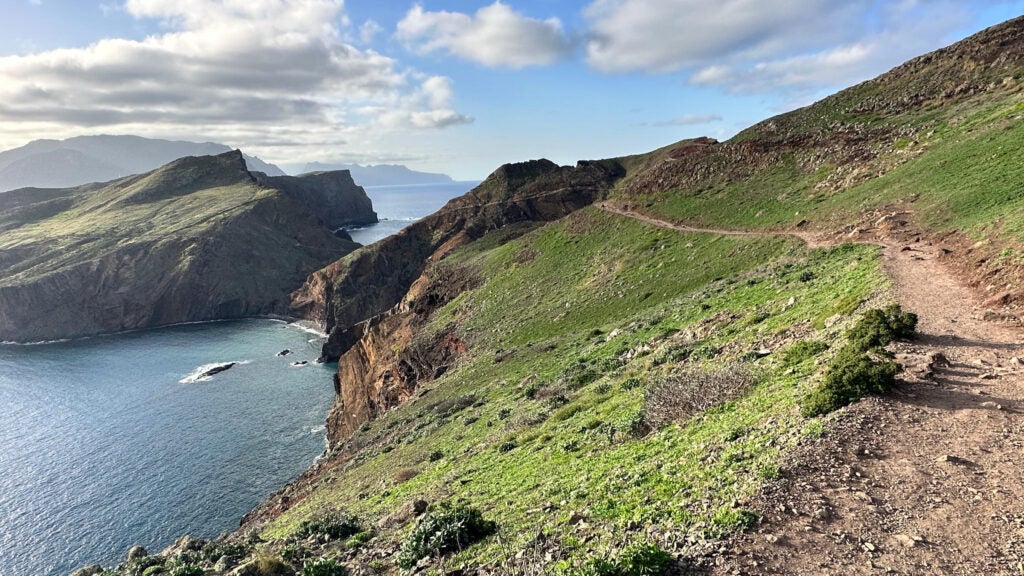
My partner and I sat for a few minutes looking back along the switchbacks crossing the terraced hillside to the ocean 1,000 feet below. Every trail we’d hiked in Madeira at that point had been quite steep, but the sheer cliffs, densely forested interior, and brilliant blue water made for some of the most incredible landscapes I’d ever seen. The quad-burning climbs were worth the effort.
We did end up hiking more reasonably graded trails, and all of them varied wildly in scenery and terrain. We were on a 23-day, four-country trip to Europe, and as excited as I was for all our stops, I had most been looking forward to Madeira.
We had sought out temperate destinations for the late-fall trip, and made sure at least one location was hiking-focused. Madeira, a Portuguese island situated 320 miles west of Morocco, fit the bill perfectly.
The lodging and travel to and from Madeira was reasonably priced during the shoulder season, and the weather was between 60 to 75 degrees Fahrenheit every day. The trail network on the island was incredibly well-signed, developed, and robust. We didn’t plan much in advance, but still managed to hike to a massive waterfall, from the top of cliffs down to the ocean, along winding routes along the coast, and between the two highest peaks on the island. The day-hiking trails are all beautifully constructed and follow a numbered PR system, which translates to Pequena Rota, or Small Route. Here are the trails we explored, plus some advice for your own trip.
PR 8: Dragon’s Tail
Distance: 4.6 miles (out and back)
Elevation Gain: ~1,200 feet
I used to have an aversion to the most popular or Instagram-worthy destinations, but I’ve moved past that. By and large, these attractions land at the top of listicles for a reason, and Dragon’s Tail is no exception.
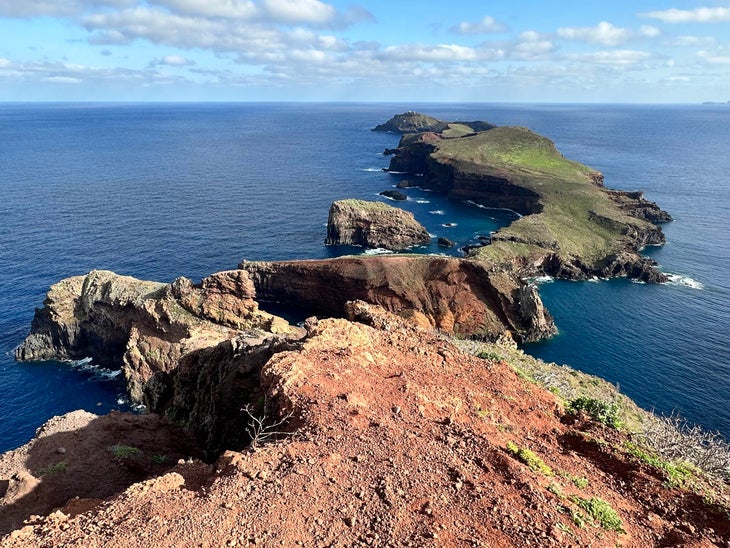
This route, officially called Vereda da Ponta de São Lourenço, follows winding coastal features with panoramic views the entire time. This trail felt crowded at first, but the hikers dispersed naturally along the route. The trail starts by descending a set of stairs with 360-degree views of contrasting red rock, green groundcover, and blue water, and you traverse the edge of these features for 2 miles before climbing steeply to a lookout at the very edge of the coast.
I underestimated the elevation gain of this hike, and the steep final climb took me by surprise. We huffed and puffed to the top and spent some time enjoying the view before hiking down to the cafe at the base of the climb for sodas and fresh-baked banana bread. I’ve hiked mostly in the U.S., so the prevalence of unexpected cafes along Madeira’s trails was a delightful surprise. I recommend getting to this trail early, as the parking area fills up and you’ll wind up walking extra along the road if you lose out on a spot. Did we follow this advice? Of course not, but I suggest you do.
PR 1: Pico a Pico
Distance: 7.6 miles (out and back)
Elevation gain: 2,700 feet
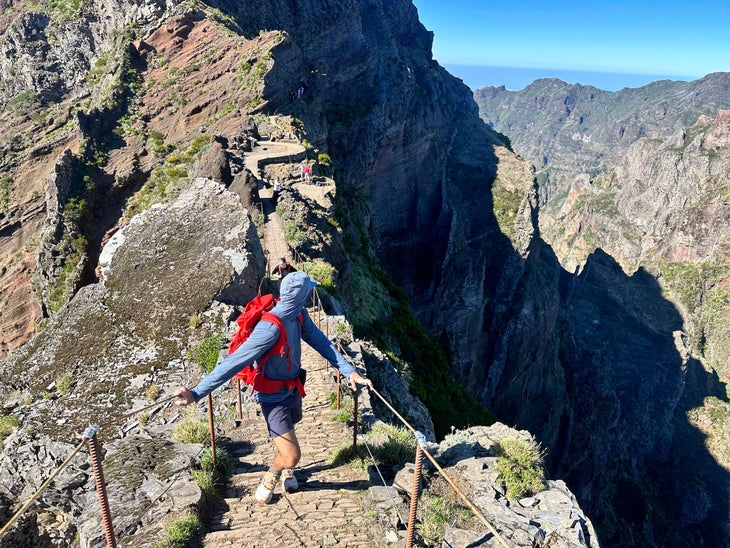
The route from Pico do Arieiro to Pico Ruivo is commonly known as Pico a Pico, or “peak to peak.” Along with Dragon’s Tail, this is one of the most famous trails in Madeira, taking hikers between the two tallest peaks on the island, Pico do Arieiro (sometimes spelled “Areeiro”) and Pico Ruivo on a narrow, steep trail with views of jagged peaks in every direction.
The trail is another marvel of engineering, with tunnels, handrails, and thousands of stone steps. Some steps are wide and easy to navigate, while some are so tight, steep, and winding that vertigo had me gripping the cable handrail for balance.
Most people begin at the large trailhead-shop-cafe complex near the summit of Pico do Arieiro at around 5,900 feet. The trail loses elevation to the saddle at 4,900 feet, though there are plenty of short, steep climbs in between. This means there is more elevation gain and loss than you’ll see on a generic elevation profile, and it was harder than I anticipated (par for the course with me).
The trail is easy to follow, tracing a natural ridge with dizzying drop-offs on both sides and some cliff-hugging sections. Sturdy cable rails surround the narrower sections, and while I never felt unsafe, hikers with fear of exposure might find it unnerving.
At the saddle, the trail begins climbing steeply toward the summit Pico Ruvio at around 6,200 feet, with more ups and downs along the way. You’ll reach a false summit and, like with all false summits, question why you were born. This was where my partner and I had to choose whether to continue toward Pico Ruvio or turn around. Most people book a transfer back to their car or shuttle spot from the summit of Pico Ruivo, eliminating the miles and climbing back to Pico do Arieiro. We did end up turning around, but I wish we’d planned enough to book the transfer. In the end, the views were astonishing and the trail was challenging enough to feel like an accomplished day anyway. Set aside a full day for this hike, and, again, try to get to the parking area early in the morning.
PR 9: Levada do Caldeirão Verde
Distance: 8.6 miles (out and back)
Elevation Gain: ~800 feet
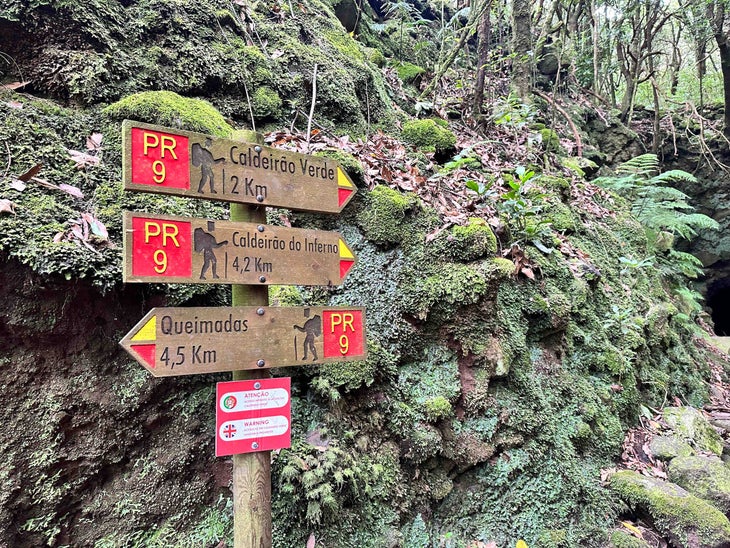
Levada routes are some of the more moderate trails on the island, following irrigation infrastructure that brings water from rainier parts of the island to more arid areas. This route started in the Queimadas Forest Park and has the option of finishing at the Caldeirão do Inferno, which would have been just under 11 miles round trip. We stopped a bit earlier at Caldeirão Verde, a strikingly tall waterfall in the middle of dense, misty forest.
The route was largely flat, following stone walkways and hard-packed dirt next to dripping, moss-covered rock walls with the levada running parallel to the pathway. We went in and out of multiple tunnels where we would have benefitted from a headlamp. Most of the trail was on the edge of a massive drop-off that offered dramatic views of the primordial interior forest. The wide path eventually narrowed to a steep, narrow climb to the waterfall where we ate lunch and visited with the friendly and fearless birds hopping around hoping for a handout.
The hardest part of this route was the trip to the trailhead. Be ready to drive harrowing, windy roads to the Queimadas parking area, and bring your wallet because it costs a few euros to park. I’d also recommend leaving some time for the thatched-roof visitor center and trying pastel de nata—a classic flaky-crust-and-custard pastry—at the cafe.
Vereda da Ladeira
Distance: 3.5 miles (out and back)
Elevation Gain: ~1,500 feet
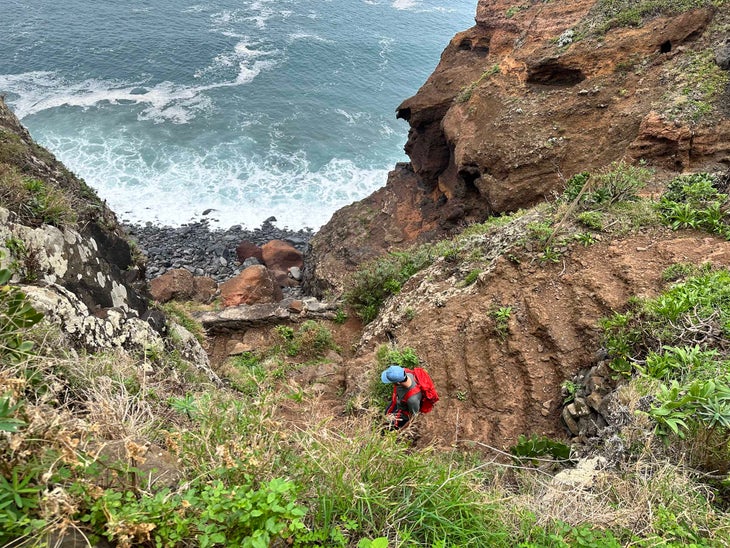
This steep trail was only 15 minutes from our hotel in Porto Moniz, and we found the trailhead near a signed miradouro—or viewpoint—with a tiny parking area. This route descends from the top of the cliffs down to the water’s edge on the northwest coast at the tiny town of Fajá da Quebrada Nova, formerly home to hundreds of people living and working on small farms.
We started on a series of switchbacks along farmed terraces, with some loose sections of rolling pebbles and rocks. At the bottom of the first climb, we reached a vegetated drainage that we had to cross via a rickety bridge that was missing a few key planks. It felt stable enough though, and we continued down the second part of the descent to incredible views of the ocean on steps cut into the rock above a stone retaining wall.
At the base of the climb, we hiked through tall grasses until reaching the tiny, near-empty town a quarter mile away. We followed the walkway west for another half mile and ate lunch at a lookout before heading back. This area actually has a cable car that travels up and down the next cliff from where we started, giving hikers a point-to-point option to skip the out-and-back, or to avoid the hike entirely.
Tips for a Madeira Hiking Trip
Understand the Trail System
Madeira’s network of day-hiking trails are on a numbered PR system. Visitor centers, ample signage, and information points all have maps highlighting key trails. Madeira is famous for its hiking, so you’ll find a good amount of blog posts, trail reviews, and online information with route details and directions. There are certainly less-developed trails than the ones we did, but all of the hikes we saw were well signed both along the route and at the trailhead, with developed parking areas and impressive trail infrastructure.
Rent a Car, But Be Ready For Some Overwhelming Driving
Madeira doesn’t have the most robust public transportation system, but there are plenty of reasonably priced car rental options with airport shuttles. We planned our arrival from Rome for mid-morning to ensure the rental place would be open, and scheduled a shuttle from the airport. We used Way2Madeira, a budget rental company just 20 minutes from the capital city of Funchal.
We rented a stunningly underpowered vehicle that struggled on the steep roads, some of which I swear were close to 20 percent grade. We were also surprised by everything from trucks stuck on hairpin turns to sheep and cows in the road, so stay alert behind the wheel. The trickiest driving were the smaller roads to the trails, and the highways were all quite nice. Finally, remember to load your road maps ahead of time on wifi or download the area on Google Maps if you don’t have a European SIM card.
Get to the Most Popular Trailheads Early
While Madeira isn’t the most well-known destination in Europe, it is renowned for its trail network and incredible coastal scenery. This meant that plenty of visitors, like us, were there for the hiking. I’d recommend getting to the most iconic hikes (Dragon’s Tail, Pico a Pico) by 7am, as even the largest parking areas fill up fast. The hikes never felt too crowded, but if you don’t get there early, plan for a longer walk from a distant parking spot.
If Possible, Stay in a Few Different Places
We started our trip in Porto Moniz on the northwest side, then moved to the capital city of Funchal on the southern coast for the second half of the trip. This allowed us to explore different parts of Madeira and made it easier to access various trails across the island. I absolutely loved the Aqua Natura Hotel in Porto Moniz. We had an ocean-view balcony, and the hotel has its own world-famous natural pools with ocean waves crashing into the manmade basins. Our hotel in Funchal was as far from boutique as you can get, but included a massive buffet breakfast, multiple pools, hot tubs, and gardens, and was walking distance to plenty of food and attractions.
Leave Yourself an Unplanned Exploration Day
We spent our Porto-Moniz-to-Funchal transfer day exploring, stopping for a few short hikes and viewpoints along the way. We hiked to ancient trees, hilltops, and miradouros with no other tourists nearby. The top of the island was totally different terrain than the mountainous interior or coastal cliffs. It had rolling plains covered in short grass with desert vegetation, all dotted with fuzzy-haired cows. It was a great way to spend an unplanned day, and I highly recommend it.
link