


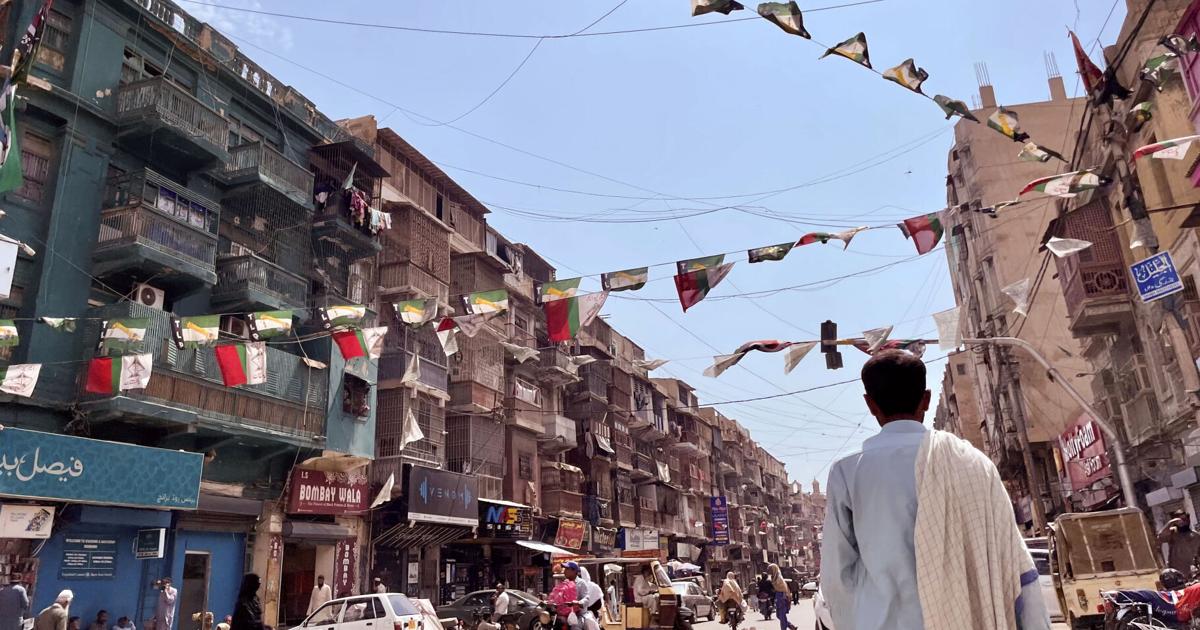
The mind comes awake moments off a plane in Karachi, Pakistan, one of the best food cities in the world.
The city spills traffic and people from every endless direction, alleys and side streets. Cars carve new paths, turning a two-lane road into four lanes and then five. Women ride side-saddle on the back of motorcycles and a baby on the gas tank, leaning against his father’s chest. Buildings are covered in decades of electric wires and curling sheets of corrugated steel. And every once in a while, through the mess, you see a piece of stonework and know there’s a beautiful old building under the chaos.
Overhead, hundreds of birds circle. They are kites, birds as big as hawks, swooping down to eat pieces of meat fed to them by residents. It’s a ritual — charity meat for the birds — and pieces of beef are sold on the street for the purpose. It creates a ceiling of birds in the city, filling in the spaces between the buildings and the sky.
On the ground, people greet each other in Urdu. “As-Salam-u-Alaikum.” “Peace be with you.”
Urdu is a relatively new language, developed in the 12th century as a kind of trading language to communicate in this crossroads of the world. Iran to the west. Afghanistan just over the border. Uzbekistan to the north. China to the east.
You taste it in the food and hear it in the words: shapes of Sanskrit, Turkish and Arabic.
My first real introduction to Pakistan, like so many people, was in the weeks after 9/11 when the New York Times sent Rick Bragg there. He wrote a NYT Magazine cover piece under the headline “Why They Hate Us.”
In his book “The Nine Lives of Pakistan,” Declan Walsh writes, “After 2001, when the attacks on America thrust Pakistan to global prominence, the country occupied an uncomfortable place in the Western imagination, as a crucial yet perfidious ally. … News stories were invariably accompanied by photographs of rabid-looking clerics torching American flags. Successive opinion polls ranked it among the least popular countries on Earth.”
That was more than 20 years ago, and a huge generation has grown up since. According to a United Nations report, 64 percent of the country is younger than 30.
We came here for so many reasons, but mostly to understand a part of the world that I only know from headlines.
From the air, Karachi was the color of sandcastles and seemed to sprawl in every direction from the water.


Decorated trucks wait near Seafood Street, not far from the busy port of Karachi. Truck art in Pakistan goes back to the 1920s. Truck owners paint and decorate to reflect their hobbies, political views and dreams.
Fifteen million people live in Karachi, goods flowing in and out of its busy deep-sea port.
We started there, at the port.
Karachi is one of the great food cities of the world, organized in a series of food streets.
“We live to eat,” said journalist Naimat Khan as he walked us down Seafood Street during our first moments in the city.

Crab soup on a cold night is a crowd favorite at Keamari seafood market in Karachi.
Lights hung over the street. Carts were full of rows of freshly caught fish. A man stood over a pot of peppery soup, cracking crab claws to add meat to the bowl we ordered.
Smoke rose from the grills as they prepared our prawns, snapper and flounder.
Nearby, a stand sold makti chai, hot milk tea served in clay pots.
Pakistanis eat with their hands. I watched the way Naimat took two fingers and pulled a piece of spiced, grilled fish off the bone and folded it into a piece of hot, blistered bread.
This was only our first stop on a long night of eating.
As we left Seafood Street, we walked by a row of buses, elaborately decorated. These folk art buses and trucks would become a familiar sight on the highways as we traveled, painted with religious and political images and shoutouts to favorite cricket players.
We posed with the buses, and a driver happily let us jump onboard to look around and take more photos.
Then it was time for more food. We headed to famous Burns Road, a long street of restaurants and food stalls.
We tried Mazaidar chicken haleem, cooked down overnight into a kind of stew and one of the most delicious things I’ve ever eaten.
We tried chicken biryani with hot piles of roti, fry kebab, dahi barray. Sweet and cheesy rabri.
The air was full of spices. Turmeric, cumin, cardamom. Smoke from the meat cooked on roaring fires on the street veiled everything as we walked.

On a famous food street full of famous restaurants, Waheed’s on Burns Road is among the best known stops in Karachi.
We ate for six hours straight.
It was almost midnight when we finally admitted we couldn’t eat anymore, and we had an early morning.
We were headed west to Baluchistan — a remote, thinly populated part of the country. We wanted to take a train through the famous Bolan Pass, and we wanted to learn something about the Baluch people.
I had been reading “The Wandering Falcon” by Jamil Ahmad about the honor-bound tribal areas of Pakistan and Afghanistan, and I was ready to learn more.
Mud volcanoes on the coast

A decorated truck drives through Hingol National Park.
In the south of Baluchistan, this remote western corner of Pakistan, the land feels like it is in motion. Two plates struck and pushed up sheets of geology, the limestone, sandstone and lava layers upended into the shape of jagged mountains.
Mountainous piles of rolling scree left behind by retreating glaciers. All the eye can see are stones of all sizes, from boulders to pebbles, all spread out on salty white sand.
You have to look closely to see the life here. A few flowering succulents in the shade of some scrub brush. Ants.
I started to wonder, “How does anyone live here?” Then I remembered. We haven’t seen anyone for hours.
Baluchistan takes up the largest amount of land in Pakistan but is the most sparsely populated.

A man sits at the base of the Chandragup mud volcano. According to the NASA Earth Observatory, the tectonic plate underlying the Arabian Sea is diving beneath the Eurasian continent, creating volcanoes that spew mud and methane.
The people who do live in the highlands of this region have long been semi-nomadic, moving sheep and goats, cattle and camels between seasonal grazing lands in Pakistan and Afghanistan. Borders and political lines drawn over the past 100 years have restricted movement, just as they have for nomadic people all over the world.
As we were to see, the urban centers in Baluchistan are growing and people make a living in other ways — employed by the military, police and security forces; oil fields; coal, gold and copper mines; and creating an underground economy moving goods and fuel across the border from Iran.
On our first day, we drove from Karachi to the Hingol National Park, a gateway to Baluchistan. Within the park is a chain of active mud volcanoes, among them the Baba Chandragup volcano, a sacred pilgrimage site for Hindus.
As I climbed the 461 stairs to the top of the volcano, I remembered that this was a pilgrimage and not an athletic endeavor.
I slowed down.

Within Hingol National Park is a chain of active mud volcanoes, among them the Baba Chandragup volcano. A total of 461 stairs lead to the top.
We traveled across the world to get to this place. We drove through the salty desert and down a dry riverbed.
As we climbed, little clouds of dust kicked up behind our feet and blew away.
The sky reflected the Arabian Sea just over the ridge. The wind blew from the sea in one long steady breath.
I braced myself against the wind and kept climbing.
Next to the stairs were pieces of coconut shell and bottle caps, the detritus of things other pilgrims threw into the volcano as offerings for the forgiveness of sins and the answering of prayers.

Hinglaj Mata Mandar in Hingol National Park is a revered cave temple and pilgrimage site for Hindus.
We were later given coconuts, too, by the priest at the ancient Hinglaj Mata cave temple nearby.
The mud volcano is considered an embodiment of Shiva. Hundreds of thousands make the trip each year. Somehow, we were alone.
According to notes with a NASA satellite image of the volcanoes, the tectonic plate underlying the Arabian Sea is diving under the Eurasian continent, creating volcanoes. But instead of lava and sulfur dioxide, these volcanoes are spewing mud and methane.
I sat to take in the view and the feeling of an open-top volcano, filled to the edge with mud. Earl stepped around me to walk the full circle of the top, and the rubbery edge of the volcano gave under his foot just a bit and rippled toward the mud in the center.
I looked out on the vast expanse — this gurgling part of the world. In case the volcano could hear, I wished for health and happiness and time.
As we walked down the stairs, a truck had pulled up next to ours and three armed police stood there, watching us descend.
To travel to Baluchistan takes patience and paperwork. We applied for the visa months in advance and then for the permission letters for the places we wanted to visit. They are careful with foreign tourists and guarded us the entire time we were there. SOP, our guide said. Standard Operating Procedure.
Police escorts drove with us on the road. Police stood outside our hotel room at night. Armed guards rode in the car with us for legs of the journey.
They ate with us, posed for selfies, and offered us tea at checkpoints and urban stations.

To travel to Baluchistan takes patience and paperwork. They are careful with foreign tourists, escorting them from place to place, monitoring and communicating their movements.
After the volcano visit, the police joined us for lunch at a roadside restaurant. In a three-walled cinder block building, a boy shaped dough into flat rounds and tossed it against the sides of a hot clay tandoor oven buried under the floor at his feet. The dough cooked and blistered, and he took two bent wires and pulled the cooked roti bread off the oven wall and tossed it into a basket. Seconds later, the hot bread was on our table.

Boys pull hot bread from a tandoor oven at a restaurant near Kund Malir Beach in Balochistan, Pakistan.
We tore pieces of it with our hands and scooped up lentils and chicken. I was getting used to eating with my hands.
The men watched but didn’t say anything. All around the restaurant, I could feel the men aware of me, watching but not looking directly, not approaching, not talking.
For most of the trip in the rural western belt, I was the only woman in the room. In public, men and women live separate lives.
We drank cups of milky tea and then drove toward the sea.

A fishing boat sits along the dramatic Makran coast on the Arabian Sea.
Our drive along the dramatic Makran Coastal Highway followed the path of Alexander the Great in 327 BC. This is ancient Babylon. This is the edge of the Indus civilization, dating back to 2500 BCE, one of the earliest known urban civilizations in the world, second to Mesopotamia and Egypt.
We stayed in a bungalow looking out on the sea. We were the only tourists staying there.
Cliffs rose to the left of our view. Fishing boats lined up on the horizon.
Men rode motorcycles on the beach, two to a motorcycle.
The sun set on the empty beach, reflecting orange and pink in the still water of the receding tide.
What do you do for fun?
When it rains in the desert, the ground doesn’t know how to drink. At first, it was just a few pools of milky green alkaline water. Then the dry riverbeds started to fill, and then overflow. Soon the road was covered.
The water poured over the side of the bridge, forming a fast-moving flood that spread beyond the riverbed and into the surrounding town. Hundreds of blue plastic containers used for transporting fuel from Iran, 20 miles away, floated all around us.
The water had come up so fast, rising beneath the tires of moving traffic, we had no choice but to press on to make it to the other side.
Young men hung off the sides of trucks, filming it all. Two men pushed full fuel containers through the water of an otherwise empty lot. A man led his son through the watery streets, his white robe wet to the waist.
In 2022, more than a third of the country was underwater in a devastating flood. The country is still recovering.
Pakistan is especially susceptible to climate change. Increasing rainfall matched by melting glaciers. While we were in the southwest of Pakistan, traveling through coastline and deserts, the north of the country is home to more glacial ice than anywhere in the world outside of the polar regions.
During the floods of 2022, climate impact scientist Fahad Saeed told BBC News that people with the smallest carbon footprints are suffering the most.
“The victims are living in mud homes with hardly any resources. They have contributed virtually nothing to climate change,” he said.

Men wade through floodwater on the road to the port city of Gwadar, Pakistan.
We drove through the rising waters and arrived at our destination: the port city of Gwadar.
Gwadar was purchased by Pakistan from Oman in 1958, adding a strategic port at the mouth of the Persian Gulf. The city is a hammerhead shape, jutting out into the Arabian Sea.
When we pulled into town, the streets were full of water. The sprawling street market was closed. The metal doors of stalls were pulled down.
As we drove through the maze of flooded streets, people standing under awnings pointed us down the safest roads. Other drivers rolled down windows and told us where they came from and what we should avoid. We did the same.
Cows stood pressed against the buildings.
Stacks of wood for the tandoor were getting wet.
Some men held out hope for customers and stood in the rain with piles of watermelons; carts of cauliflower, garlic and tomatoes; wheelbarrows full of onions.
Our hotel was above the town on the edge of a cliff with sweeping views of the entire town, the deep-water port and the Arabian Sea. To get there, a steep narrow road climbs up the side of the cliff.
The hotel is heavily guarded. We showed our passports and permission papers at a Navy checkpoint before being allowed on the road to the hotel.
The hotel made headlines in 2019 when Baluch separatists attacked it, targeting Chinese investors. They claimed responsibility on Twitter, now known as X.
Baluchistan is the site of several Chinese infrastructure projects, the biggest being the port in Gwadar. According to the New York Times, “China is estimated to have spent around $62 billion on the so-called China-Pakistan Economic Corridor, an investment that is part of China’s Belt and Road Initiative, a $1 trillion chain of infrastructure development programs stretching across around 70 countries.”
During the night as the rain continued, a sinkhole the entire width of the steep entry road opened beneath a car. Rocks and mud spilled onto the road below and blocked our way out.
The Navy came in to fill the sinkhole with truckloads of sand.
The rain continued. Towels and sandbags were next to every entrance of the hotel.
We drank tea and waited. We went for a walk around the hotel through the empty streets and marked-off lots for a future housing development that looked out on the sea. A fresh mudslide flowed through a gazebo at an overlook.
By early afternoon, the sun was out and the sinkhole was filled and passable. We took our chances and made it back to the highway.
The news later reported that a state of emergency was declared in Gwadar after 30 straight hours and 7 inches of torrential rain and flash flooding.
It was a strange and guilty feeling, mixed with relief, as we emerged from the flooded zone onto dry highway and sunny skies.
It was late in the afternoon, and we hadn’t eaten.
We had a rule on our drive through Baluchistan to choose restaurants by the number of trucks there. The more trucks, the better the food.
We saw a place packed with trucks that had just made it through the same weather, and we pulled over.
Fifty or 60 men sat on carpets eating hot bread, mutton and lentils, and sipping green tea. The carpets and pillows were still soaking wet from the rain but starting to dry in the sun.
I had worried aloud the day before that we were seeing so much incredible landscape but we weren’t getting to know any Baluch people.
As we waited for our food, our guide said to me, “All these men are Baluch. Do you want to meet them?”
He jumped up before I could hesitate and told the men that I wanted to ask questions about their culture. I had to get over any shyness quickly because they loved the idea. All the men left their meals and gathered around.

Truck drivers on the highway outside Gwadar pose with Autumn Phillips after some lively lunchtime conversation.
One man opened his palm and gestured for me to come over and ask what I wanted.
I asked, “What do you do for fun?”
Wrestling! They described a traditional form of wrestling called koshti. And they enjoyed hunting birds with slingshots and playing marbles.
I asked, “How has life changed here in recent years?”
“It hasn’t,” one man said. “In fact, it has gone backward.”
And then everyone gathered for a group photo and selfies.
As we ate after that, everyone was giddy from the encounter and comfortable, and we took our time eating as the sun warmed the humid air.
We practiced saying goodbye in Urdu, “Allah hafiz,” so we could make a good impression on our way out.
A look behind the curtain
There’s an image from Pakistan that I can’t get out of my mind. I saw one man. The sun was setting. It was snowing and had been all day. We were in the mountains.
And this man was inside of an empty market stall, the metal door rolled up. Nothing for sale in there. He was by himself, sitting next to a little cooking fire. We made eye contact for a moment.
Then I noticed that all around the mountainside, people were lighting cooking fires. Smoke rose from inside the walls of compounds, and men sat by themselves outside. We were driving back to our hotel in Quetta.
I’ve been turning that image, that glimpse that I caught from the car window, over and over in my mind since I saw it.
That moment stays with me because it felt like I saw inside for a second, behind the curtain. But I don’t fully understand what I saw. And for me, that’s the theme of that whole trip to Pakistan.
Snow falls on a mountain mosque in the Ziarat Valley in western Pakistan.
The beginning and end of our trip were easy: visiting English-speaking friends, many educated in the United States. They translated the culture for us and we sat in mixed company, the women speaking as freely as the men.
But Baluchistan, the sparsely populated western region we came to visit, was harder to understand.
We started our trip with a visit to the Karachi Press Club. The journalist who gave us a tour presented us with a scarf with an ancient pattern that has become the mark of the Sindh region. We saw the podcast studio and stage with green screen and news desk for anyone to give a report. I looked at the room with four computers set aside for women to write.
The club was a place for journalists to work and to socialize, but it was also something else. It was a place for people to protest outside and have their protests recorded. On the walls outside the gates were murals and graffiti about the people of Gaza, written in English.
We ended our trip at the Karachi Boat Club, a colonial remnant overlooking the mangrove shores of Chinnah Creek off the Arabian Sea, built in 1881 as a rowing club. Dark wood paneling. Members only. No photos allowed. Strict dress code. No cellphones.
These spaces felt familiar and the conversation was easy. We sipped chai and spoke freely, and I was acknowledged.
Between bites of cake and sips of chai, I asked the table, “What does it mean to be Pakistani?”
The answers came pouring out.

A string cot and chicken coop sit outside a restaurant near Ormara Beach on the Makran Coastal Highway in Pakistan.
It means something different to everyone. It means something if you are Pashtun, Punjab or Baluch.
It means family values.
It means one word, “Resilient. If you know how much people had to do every day to survive, you wouldn’t wake up in the morning.”
It means dealing with hyperinflation and skyrocketing utility bills and food prices.
It means being engaged in politics, where the recent election had a 50 percent turnout, where 60 percent of the country is younger than 30 and 10 million people were eligible to vote for the first time.
We arrived in Pakistan weeks after the election.
People had gone back to work after days of protests. Chief minister Sarfraz Bugti had been chosen, and we were in Quetta on the day he was installed. He walked through the lobby of the Serena Hotel with his entourage and greeted everyone, including Earl.
We sat at a table in the corner, playing Ludo on cardboard our guide bought in the market after I said I wanted to learn to play.
We rolled our dice and moved around the board, and the guide and driver relaxed into themselves as they became competitive and told jokes and laughed easily.
We passed the time in this way as we waited for permission to travel to nearby Ziarat in the mountains. We had already been denied permission to stay there overnight for our safety.
Then we got the word and headed over to the police station. They poured us tea and gave us chunks of raw sugar to place in our teeth as we drank, as people do in that area. A ceramic space heater glowed in the corner.
They smiled at Earl and asked where we were from and then introduced us to our guard, a man with an AK-47 who would ride in the front seat of our car.
As we drove into the mountains, before the snow began to fall, flags floated from every building and over the streets like prayer flags, but these were to advertise various political parties. Some had designs like the head of a lion, and some had the faces of local candidates.
This part of the world is war-hardened and weather-hardened.
But Japanese tourists come here in droves to see the cherry blossoms in the spring. Between the road and the mountains are rolling orchards. Cherries. Almonds. Apples. Plums.
Along the side of the road were makeshift huts, housing the latest mass of Afghan refugees.
They’ve been coming here since the Soviet invasion in 1979, in waves. Some never leaving. In that first wave, they brought Afghan carpets, and tourists would come to buy them at reduced prices. They are still for sale in shops in Quetta and Karachi. The number of refugees spiked again in 2021 after the Taliban takeover.
In late 2023, the Pakistan government announced that all undocumented Afghan refugees were being expelled. An estimated 1.4 million Afghans are living in Pakistan as registered refugees, according to the Associated Press. Those without paperwork were ordered to leave by Oct. 31. Police were told to arrest 10,000 a day. We were told that deadline was pushed and they were given an extra six months to leave.
According to the National Institutes of Health, the U.S. gave $60 million to the regions of Pakistan hosting Afghan refugees in 2022.
In his book “The Nine Lives of Pakistan,” Declan Walsh writes, “The United States and Pakistan had been feuding and falling in love for decades. People often compared their tempestuous, co-dependent relationship to a bad marriage, but it was more accurately the worst kind of forced marriage — a product of shared interests rather than values, devoid of genuine affection and scarred by a history of dispute and betrayal.”
Limited movement
We were in the lobby of a hotel in Khuzdar, in central Baluchistan. The police were outside, and they were not letting us go out into the town. If we wanted to eat, we could order food.
Then came the news that the hike to Moola Chotak we planned for the next day — to walk up a canyon riverbed to a beautiful waterfall — was not possible because of the flooding.
Weather and security were turning our trip into a drive from hotel to hotel.
Our guide delivered the news. We would head to Quetta, then catch a flight back to Karachi a couple days earlier. He offered to take us around Karachi.
I started to tear up out of frustration. Why had we flown 26 hours and driven for days only to be kept in rooms and cars? How would we ever understand this place?
Earl and I went back to our room. The window looked out on the parking lot and the police posted outside. I wondered aloud, “How can we salvage this trip?”
Part of the plan was to take the Bolan Mail train for an hour and a half, just long enough to see the famous Bolan Pass. Then a car would meet us and take us to the airport for Karachi.
What if we took the train all the way — 25 hours from Quetta to Karachi?
The plane tickets had already been purchased and couldn’t be refunded, our guide said when I walked back out into the lobby to ask if it was possible.
That’s OK, I said. Taking the train will make me happy.
That’s what I want more than anything, he said. I’ll have news by the morning.
The Bolan train
Almost as soon as the train left the station, people began to approach us.

A man greets travelers on the platform of the Quetta Railway Station in Pakistan, selling tea, eggs and bread.
“We saw you on the platform having tea and we were surprised. We have been waiting to meet you,” they said. We were the only foreigners boarding the Bolan Mail train, from Quetta to Karachi, Pakistan.
Twenty-five hours on a train through treeless desert, and there’s nothing to do but talk and drink chai and look out the window at the passing countryside.
Every train has a culture, and the Bolan Mail is a social train.
The guards and police fell away when we boarded the train, and this was our chance. Our social life immediately picked up.
First a group of young men sat down. They were all in their 20s, unemployed and heading to Karachi to seek their fortunes. Several people were taking the train for medical tests and procedures. Some were heading home from weddings, the women with henna on their hands.
We didn’t speak Urdu and they didn’t speak English, so we passed the phone back and forth with Google Translate.
Well, they did.
To travel in Pakistan as a woman is lonely.
The men gathered around Earl and talked.
The only time they looked my way was to show me a photo of a man’s child on his phone.
I sipped tea and listened and looked out on the landscape.
“Tell me, is life easy or is it hard?” one man asked.
I’ve long tried to figure out the best question to ask during language barrier small talk, after “Where are you from?” and “How many children do you have?”
I’ve always looked for something to ask that would start a real conversation.
That’s the best question I’ve heard.
It’s the hardest and easiest question to answer and could lead to hours of exploration, depending on the amount of thought and time you want to give it.
And how do you answer in this war-hardened place?

Train engineers are told to test their brakes before entering the Bolan Pass in western Pakistan.
Outside, the train rolled through the famous 55-mile Bolan Pass, one tunnel after another. About 75 miles from the Afghanistan border, the cliffs rose up on either side, the rock a color of sand that I recognized from history books and etchings and the news.
On this train, you must work to see where you are. The windows don’t come down and they are coated with years of desert dust.
In order to see the tunnels and the pass clearly, you need to go between the cars and lean your head out of the open door.
I’ve never wanted a geologist with me more than my trip to Pakistan. The landscape was stirred and folded and shaken. It is an open book if you can read it.
When you are on a train for 25 hours, the world outside disappears. It’s like swimming in a lane. No one can reach you there, and the sound of metal wheels on metal tracks creates a kind of silence.

In order to create privacy on the Bolan Mail train from Quetta to Karachi, passengers hang blankets between the seats.
The cost of a seat from Quetta to Karachi on the Bolan Mail ranges from $5.50 to $11.50. The difference between an economy ticket and the best range is the ability to lie down in your own berth and have air conditioning. There are no sleeper cars. Families who buy all the facing berths tie blankets between the seats to create some privacy.
Because we bought the ticket at the last minute, we had no such privacy. I climbed onto the top berth and looked briefly across the entire car at the other people sleeping. I finished reading the last chapter of my book, “The Wandering Falcon,” and let the train rock me to sleep.
The rotating metal fan on the ceiling blew cool air on me for a moment and then turned away.
Earl reached up and shook my foot.
“Get up,” he said. “You don’t want to miss this.”
I sat up in a fog.
“Hurry,” he said.
I pulled my hair up in a barrette and climbed down.
“Follow me.”
We wove through the length of the train, feeling the cold air between the cars as we opened one door into the next.
Then Earl led me through the boiler room and into a room full of men.

Between stops, engineers of the Bolan Mail train invited us into their room for tea and conversation.
On the floor, a man sat next to a small ceramic burner and poured cups of chai. He smiled and handed one to me.
There was something different in the room. They talked to me. Just like the truck drivers had earlier in the trip.
They introduced themselves and said they had spent their lives working for this train — no one less than 20 years. Three days on the train and three days at the home station. They had degrees in electrical trades and took regular trips to Islamabad for certificates and refresher courses.
I started to notice the bedding pushed against the wall. We were in their home.
We sipped the hot tea, and they explained the inner workings and the maintenance.
As they talked, I thought back on our time on the train and saw why it was not like other trains I’d taken across counties and over borders all over the world.
Other trains swayed and clapped and stopped unexpectedly for repairs. This one was well run. It almost floated from one part of Pakistan to the other.
It did not break down while we were on it and ran on time.
As suddenly as the moment began, it was over. The men put down their teacups, said goodbye to us and got back to work as the next station approached.
We walked through the boiler room and back to our seats, glowing from the experience.
The train pulled into the next station, and we got out.
A young fashionable couple walked by, and Earl asked if he could take their photo. The man posed with Earl as the woman stepped away and turned her back and covered her face.
A little girl standing with her parents ran over and asked if she could have a photo with me. We posed together, and a minute later she returned with a small chocolate bar for me. I gave her some perfume samples I had in my luggage.
Her mother smiled at me and mouthed “Thank you” in English.
With all the police denials and limited movement earlier in the trip, I had worried that I would leave knowing less than when I came.
Taking the social Bolan Mail train changed that.
The sun rose and we went to the dining car.
We ordered milk tea and a plate of eggs and Quetta paratha, a sweet, flaky piece of flatbread. We tore the bread and used it to eat the eggs.
We pulled out our game of Ludo and put it on the table. As we rolled the dice and moved around the board, the men in the car watched the game, and the man who served the tea stood almost next to us.
If they didn’t know us, they knew the game.
The sun was just starting to warm the day when we pulled into Karachi.
This was the same station where migrants from northern India arrived in the late-1940s, one of the largest migrations in human history, and also the bloodiest.
A cartographer was given a 40-day deadline to draw a line between India and Pakistan, creating a Muslim homeland in South Asia.
As we climbed the stairs from the train platform out onto the streets of Karachi, I looked out at all the people and thought about all we had seen. I thought about the strangeness of this place, where the Indus River meets the sea, where the earliest humans lived and where, somehow, things are still at the beginning.
link